
Tag Archives: Sell-side services

10 mistakes when selling your company

Are you thinking of selling your company? Are you prepared enough to avoid making any of the possible mistakes? Do you know how to manage them?

When it comes to selling a company, it is always important to put aside personal interests, since these can affect business development. We are talking about a complex process that requires appropriate advice that conveys trust, transparency and confidentiality.

The sale and purchase of companies is a lengthy procedure where you can easily make mistakes that can lead to the process’ failure.

To try to avoid this, in this article, we discuss the 10 mistakes you should never make if you want the sale of your company to be a success:

1. Failure to carry out a reliable valuation of your company

You cannot start selling your company without knowing how much your company is really worth, as you will not be able to reasonably argue the price to your potential buyers. You could be asking for a price beyond your means, or you could be unaware that your company’s real value is higher than what you are asking for.

In the following article, we would like to explain the keys to this activity and the most common valuation methods used in the market, to encourage you to carry out this important process in the most professional way possible.

2. During the sales process, changing the interests or motivations for which you have decided to sell

A good seller has to reflect beforehand on why they want to sell their company, and what they want to do after selling it. If you are not clear on this, it can be detrimental when it comes to selling your company, as the buyer may notice strange things in your attitude and become concerned. They may also interpret your insecurity as insincerity, and the buyer may start to doubt you and your company. This triggers the perception of risk and inevitably lowers the value they see in your company.

3. Negotiating with a single buyer

When you negotiate with a single buyer and they find out, they may take advantage of the situation. They will start to play with time, drag out deadlines and ask for more and more concessions.

The search for the best buyer and a good negotiation are key elements for a successful sale that reflect the business owner’s effort and work.  It is not only necessary to find a concrete offer but also a buyer who transmits confidence and peace of mind to the entrepreneur.

Therefore, it is essential not to make the mistake of selling the company to the first company or investor that makes an offer. The business owner should not make this decision without a thorough search and analysis of all possible offers and opportunities.

Finding the right buyer for a company is often a complex, time-consuming and frustrating process. It is, therefore, essential to answer the following questions:

  • What are the different types of buyers?
  • How do you know if a company is likely to be of interest to a buyer?
  • How do you find the ideal buyer?

We invite you to find out more about finding the best offer and counterpart in this article.

selling process of a company

4. Failure to manage the process with confidentiality

The sale of a company has to be a confidential process in which the business owner, accompanied by financial advisors, shows the company only to those who have a real interest and capacity to buy the company. Therefore, you should not give the sale of your company to several intermediaries as it will be challenging to maintain the confidentiality of the sale process.

You should be accompanied by an advisor, and only one advisor, during the whole process, who will work with you and take care of confidentiality. Otherwise, after a year the whole market will know that your company is for sale.

Also, the fact that it has not been sold will create a negative perception of your company. Rumours and uncertainty may increase, which would lead to the market saying that your company has been for sale for a long time because it has problems, which in turn would result in the value of your company starting to fall. Company sales processes need to be fast and targeted at genuinely interested investors.

Lack of confidentiality may cause the buyer to abandon the purchase operation and generate an absolute lack of confidence in the market about your company’s future.

It is essential to know how to correctly manage two critical aspects of handling confidentiality when selling a company.

In the internal environment, we find that many business owners make the mistake of communicating this decision to their staff or their close circle without taking the necessary care. When this happens, the likelihood of losing competitive strength increases, talented employees feel a lack of drive and look for other career opportunities, and the situation snowballs into more serious consequences such as the closure of what could have been a magnificent organisation.

It is, therefore, imperative that the employer communicates this to the right people at the right time. A positive attitude must also be maintained within the company independent of the intention to sell. This will keep your employees happy despite the change, and if the profitability of the company is maintained, the organisation will be easier to sell.

5. Dealing with the process alone, and not hiring consultants

The sales process takes many hours and a lot of work. During this process, you must focus on taking the right steps to improve your company to be ready at the time of sale. Suppose you go into the transaction without advisors. It will be very difficult to maintain confidentiality, carry out a rigorous search to find the best buyer, and at the same time, take those improvement measures.

Don’t do it alone! Buyers bring in very experienced advisors. Use professional advisors yourself: there are many pitfalls in the process of selling a company!

We remember a client whose buyer was pressuring them to sign an offer with a price, but the offer they had been made was on the company’s value and not on the value of the shares. The company’s debt had to be subtracted from the company’s value and once it was removed, the value of the shares was very low. If our client had agreed to sign such a deal without understanding the difference between the value of the company and the value of the shares, they would have committed themself exclusively to an unsuitable buyer who had also put in place a penalty clause in case our client left the negotiations, which would have trapped them in a very complicated sale.

Consultants know this and can help you avoid these traps – count on them, trust them and do not let the buyer cheat you! Often, the buyer will want your advisors to be absent, and they will tell you that it is better not to talk to them because all they do is make the process more difficult. Advisors only bring problems to lousy transaction processes, and they help improve these processes, defending and protecting your interests during the negotiation of a company’s sale. They have experience in this because they have been involved in many prior transactions.

Therefore, it is essential to use advisors who have real experience, not intermediaries, and who are professionals in financial and corporate operations. Selling a company is a very complex process in which there are many elements to watch out for and manage. Never put yourself in the hands of intermediaries; put yourself in the hands of advisors!

There is a wide range of “Advisors” from facilitators, brokers and consultants to auditors, lawyers etc. that are likely to appear in a transaction. But because they do not have a profile suited to the dynamics of a business transaction, many transactions have turned out to be unviable. This process requires very detailed and specific knowledge of techniques and dynamics that only financial advisors dedicated to companies’ sales and purchases can handle.

For this reason, when you think of advisors, you should look for those where the nature of their service is in line with their profession. In this instance, the best advisor profile is those who are specifically dedicated to the sale and purchase of companies.

6. Neglecting the business during the sale

As we have already mentioned, the process of selling a company is a long process that requires a lot of effort, so the fact that an entrepreneur would undertake this task alone is madness.

7. Focusing the operation locally

The second main mistake in selling a company is to only focus on selling the company locally. The best buyer is probably not in your country and probably not in your area. The best buyer for your company may be in another country.

You have to take a broad approach; you have created a lot of value over many years and it doesn’t make sense to mis-sell or sell the company quickly to the first individual who shows interest or to the first one who comes up with some money.

Look for somebody with the best fit, and the best ability within that fit to pay your company’s real value.It is unlikely that the potential buyers in the area will happen to be the ones who will create the most value for your company, nor the ones who will pay the most for it.

8. Failure to consider, where appropriate, that there are other minority shareholders (probably with different motivations or particular interests)

All shareholders must agree with the company’s sale; otherwise, the sale operation may be jeopardised, and all the effort and costs invested may have been wasted. They must be involved in everything that affects the company.

9. Wanting to sell in a hurry

Every day we see in our daily lives that when we do something in a hurry, things end up going wrong, and we lose time that we will never get back. The same thing happens with your company’s sale; wanting to sell as soon as possible weakens your negotiating position and your search for the best buyer. Your buyer will notice the rush; it will make them lose confidence and will give them weapons to press their demands.

10. Not planning the process

The sales process must always be planned. Otherwise, you can lose value at every stage. Disorder only brings risks and surprises that lower the company’s value, lengthen the process and the complexity of selling your company, and greatly increase the possibility of failure.

If you are considering selling your company, you will have to go through different stages that will help you maximise the final price. Do you know what they are? Download the eBook “HOW TO MAXIMISE THE PRICE OF YOUR COMPANY” where, in a simple way, we explain how to prepare the company for its sale.

DOWNLOAD THE EBOOK >>

Due to the complexity of the process, the delicacy of what is at stake and the specific dynamics that a corporate operation requires, the recommendation is to continue with this process in the hands of a team of professional advisors whose experience and track record overcome these main barriers. So, if you are interested in selling your company, contact us, and we will help you.

The desire to sell a company can come about for various reasons. For example, the desire to embark on another adventure, the feeling that “you’ve done it all”, tiredness of a long and exhausting professional career etc. Remember that the process of selling a company starts from the moment the entrepreneur first considers the idea. To avoid making mistakes, the support of highly professional advisors with a high level of transparency and a successful track record in past corporate transactions is essential.

You should pay close attention not to make any of these mistakes. It is very beneficial to have expert advisors such as our ONEtoONE Corporate Finance team during the process to have a successful sale.


At ONEtoONE ,we have extensive knowledge of the sector and the activities of buying and selling companies as we have participated in more than 1,000 mandates. We could give you our opinion on value ranges and many other aspects of a potential corporate transaction. If you need advice or are interested in buying and selling companies, please contact us.


Confidentiality in the sale of a company

Confidentiality. This is perhaps one of the first words spoken in a conversation between an entrepreneur who has decided to sell their company and those to whom the decision is revealed, including the advisors in the transaction process. You are not wrong to demand confidentiality, as this is key to the success of the operation.

Throughout this article, we will explain why confidentiality is essential, the role it plays at each stage of the process, and how to enforce it.

Index 


Why is confidentiality necessary during the whole sale process?

Confidentiality: with whom and to what extent?

Confidentiality is undoubtedly the cornerstone of any company purchase or sale transaction. Therefore, in any corporate operation, the confidentiality agreement (NDA) must start from the first moment, even when the entrepreneur has the idea in their head but has not yet decided to carry it out. If you follow this recommendation now, you will save yourself from upset in the future.

You must inform certain staff members of the sale, as they will be part of the sales process. A few key members must have the information, usually the CFO; but remember to do it intelligently. You must make sure they keep the transaction secret by having them sign a confidentiality agreement when you tell them.

With this transparency and gesture of trust, you avoid suspicions arising when asking them for information. You will also reduce the possibility of them mentioning it to their colleagues. Usually, they will repay the trust you have shown them. It would be best if you did not discuss it with anyone else.

Non-Disclosure Agreement

Confidentiality allows the parties involved (advisors, buyers, sellers, etc.) to share information in the transaction without any external agent discovering it.

The mechanism that guarantees confidentiality in this type of operation is the Non-Disclosure Agreement (NDA). Previously, potential buyers who have been qualified to carry out the transaction, have a strategic plan and sufficient resources, have been provided with a blind profile, and have shown interest in moving forward with the potential purchase.

At ONEtoONE Corporate Finance, we only deal with large international groups when dealing with potential buyers. They have professional teams specialized in corporate transactions that are very clear about the importance of confidentiality.

Compliance with the NDA implies the non-disclosure of the information received (transmitted and perceived by observation). Confidentiality is an essential tool, especially nowadays. Be careful: new technologies make information much more accessible and immediate.

The signing of an NDA obliges the parties to monitor compliance with a series of obligations concerning the information transmitted, not only at present but also in the future. Non-compliance by any one of the parties can negatively affect the operation’s development and closure.

Risks of information leaks

But what happens if the information is leaked?

Transaction price variation

It is not uncommon for a market rumor to change the price of a stock. This leakage of information can overturn the initial strategy defined. On some occasions, both parties have even had to abandon the closure of the transaction.

The exit of key professionals from the organization

The management team and key people in an organizational structure may feel threatened by the proposed transaction long before the new partners arrive and explain their new intentions. Losing these professionals can be detrimental to the operation, as the buyer may back out or lower the price due to the loss of value implied by the loss of key people for the company.

«It would be best if you put in place means to prevent managers from leaving during the negotiation phases.»

One measure we have applied on occasion with the business owner has been to inform critical managers of the idea of a sale in two years and reward them with a percentage of the transaction’s value, encouraging them to work together to improve financial ratios during this period.

Other times, we define a price that we consider reasonable with the employer and indicate to the managers that they will receive a percentage of the increase on that price. Therefore, they see a clear benefit in making a significant effort for the company, since they become business owners, to a certain extent, and we guarantee that they do not leave you by surprise before closing the deal.

Confusion in the workforce

From the beginning, rumors of a new shareholder can generate nervousness among employees. This can affect their work performance and, therefore, the company’s financial results.

Concerns of customers, suppliers

News of a new shareholder situation may cause uncertainty for customers, as they do not know whether they will still be able to continue to depend on the company’s products and services, as well as for suppliers, as they do not know whether they will be able to rely on the approval of the new owners.

Confidentiality in the sale of a company quote.Without M&A advisors, it is tough to maintain confidentiality and carry out a rigorous search process for the best buyer. If you do not give exclusivity as advisors to a firm specializing in companies’ sales, do not expect confidentiality either. You cannot expect two advisors to compete to find a buyer and simultaneously do it confidentially.


Managing confidentiality during an M&A transaction

Managing confidentiality is a crucial aspect of a transaction of this type. The first people to be required to maintain confidentiality are the advisors themselves. Even before signing a mandate with them to sell your company.

It is standard practice for advisors to send a confidentiality agreement to potential clients. In it, they commit themselves not to disclose any of the information provided, regardless of whether or not they subsequently sign an advisory contract.

If you are considering the sale of your company and are contacting different advisors, do not hesitate to request this confidentiality agreement to safeguard your sensitive information and future operation.

Focusing on the buying and selling process, sellers usually look for higher confidentiality levels, but this depends on many factors and can vary.

For example, if the seller wants a high level of confidentiality, they must reduce the number of potential buyers reached, which will slow down the sales process.

On the other hand, if the seller is looking for faster results, they must broaden the potential buyers’ selection, making it more difficult to control the confidentiality factor. This may seem like a conflicting contradiction to any seller.

Strategies to guarantee confidentiality

It is possible to use different techniques during the buying and selling process to increase confidentiality, but many business owners are not even aware of them. Here are some of these techniques:

The creation of a Blind Teaser

The Blind Teaser is a document designed to protect the company’s identity from being revealed upon presentation to potential investors. The teaser reveals the company’s status, but not its name. The buyers who show interest must sign a confidentiality agreement to protect their identity.

The signing of an NDA

Confidentiality is crucial from the first day. There will be many agents involved in the process. Everyone exposed to this information must sign an NDA so that the idea and intent are protected and secure.

Letter of Intent

The Letter of Intent (LoI) is a document in which the buyer and seller put in writing the main points of the agreement they have reached. This text must include all relevant details:

  • Type of transaction: capital raise, purchase of assets and liabilities (and which assets and liabilities), or shares.
  • The price.
  • The percentage of the company acquired.
  • The methods of payment.
  • Payment terms and deadlines.
  • Price adjustment formulas.
  • Other types of remuneration.

The confidentiality of the agreement and a period of exclusivity (in which the seller cannot negotiate with other buyers) are also agreed upon while the Due diligence and the purchase and sale contract are being developed.

Virtual Data Room

If a deal has reached the point where is necessary to create a Data Room, it means that we are close to closing the deal. In other words, we are at a sensitive point where confidentiality is vital. Hence why the Data Room is designed to protect the information. They create a virtual space where the seller will hand over all the necessary documentation to the potential buyer in order to proceed with the transaction. Information delivery is done through online software that prevents printing of the contained documentation, avoiding uncontrolled data leaks.

Confidenciality_Data Room Objectives

How does the Virtual Data Room contribute to confidentiality during the sale process?

A Virtual Data Room (VDR) is a virtual space where the seller uploads all the necessary company documentation so that the buyer can have access to it and progress with the process.

This information transaction is extremely sensitive. It should only occur when both parties have reached a reliable and trusting relationship. At this point, the willingness of both parties to invest and close a transaction is implicit.

This information transaction is carried out through software designed to avoid any revelation of documents and to maintain the safety of uploaded documents. The software must be a high-quality product that provides confidence, security, and safety to both parties involved in the operation.

Imagine how difficult it could be for a business owner to expose the essence of his company. Aside from the emotional factors that make this operation difficult, this part of the process must meet all the requirements to guarantee security and peace of mind between the parties.

At ONEtoONE, we handle our clients’ transactions with transparency, confidentiality, and professionalism. One of our best allies is the trust we generate through our work. Therefore, we encourage you to contact us if you are looking for advice on your company’s sale/purchase. And remember, confidentiality is the key to success.

How long does it take to sell a business?

How long does it take to sell a business?

How long does it take to sell a business? After having decided to sell your company, this is one of the first questions that will arise.

There is no standard answer to this question, it depends on the complexity of the operation, and in turn, on the size and circumstances of the company to be sold. But generally speaking, the sale of a company takes from 9 to 12 months to complete. In some cases, it can take up to 18.

Time is money, and in the case of a company, quite literally. The key to maximizing the value of our company during the sale will be determined by knowing where our time and money are in this process.

Index 


Why does it take so long to sell my company? Factors affecting the selling time

There are several reasons that justify the investment of time in this operation. If you want to realise a sale with all the value obtained in a long life of wealth creation, the first and best strategic decision is to invest in hiring specialized advisers.

Selling a business is a complex process.

Factors affecting the time it takes to sell for the seller

For the seller:

  • It is the most crucial decision of their life. Considering that it is a process that they will go through only once in their life, it is normal that the preparation for this decision brings time for reflection and analysis.
  • If the company also has several shareholders, imagine the time it takes to reach an agreement between all of them about the sale’s objectives.
  • Selling your company means putting the future of your employees and their families in other hands, with the responsibility that goes with it.
  • The seller can make errors of judgment forced by emergencies, such as health problems. Even in that case, having a trusted advisor allows you to face your personal reality with the peace of mind of knowing that your company’s sale is in good hands, without having to accept the first offer that is presented to you. A good advisor can also help you identify the best time to sell your company.

Factors affecting the time it takes to sell for the buyer

Other factors that will affect the time it takes to sell your business are not under your control. These are those related to the buyer:

  • The buyer needs to check and ensure that the value of his purchase is real.
  • When it comes to investing our money, rushing is never good advice, and preparing the necessary documentation that reflects the real value of a company requires time and professionalism.
  • Ideally, if there are several potential buyers, they should work in parallel, but this is not always possible. As a consequence, this analysis time will be multiplied by each buyer who wants to move forward in the process.

Factors affecting the time it takes to sell the business regarding the process

Finally, from the point of view of the process itself, all this time is required to maximize the company’s value and carry out the unavoidable phases of a sale and purchase transaction, with all the necessary documentation and negotiations.

Doing all this while ensuring that the company does not lose value during the sale process is not an easy task.

And here another question comes as a surprise: can my company lose value during all that time? The answer is, sadly, yes.

The sale is a very long process, and if the seller dedicates themself exclusively to this process, they may lose contact with the company. That makes its results decrease and, therefore, its value.

As an entrepreneur, the time you dedicate exclusively to the sale of the company will reduce its value and the possibility of profiting from the sale.

«The best way to spend your time as an entrepreneur during the sale of your company is to dedicate yourself to it until the process is complete. It is your best contribution to the process, leaving the fieldwork to professional advisers and supervising them.»

Time frames for the phases of the sale

We arrive at the sale process itself, the hard work of analysis, search for buyers, negotiation, preparation of documentation, and closing agreements. Doing all this work effectively requires a considerable investment of time and affects how long it can take to sell a business.

Below, we outline the steps so that you can get an idea of ​​the approximate time invested in each of them:

1. Analysis phase of the company and the operation

To make the most of your time in selling your business, there are a number of initial decisions you need to make:

  1. In this first phase, you have to reach an agreement with shareholders and prepare the company for a sale.
  2. Specify whether you want to sell part of the company or all of it.
  3. Choose the type of buyer: national or international; financial or industrial.
  4. Find out whether there is a need for additional work on the development or improvement of the company.
  5. Finally, define an appropriate work schedule for the project.

This phase should not take more than 1 month.

2. Phase of preparation of the Valuation Report and search for candidates

Two documents are prepared: the blind teaser and the company’s Information memorandum.

The Information memorandum must reflect the reality of the company and its most positive aspects. This way potential investors have the necessary information to assess the purchase.

Once the analyst team has all the information about the company, they can prepare the sales notebook in 1 month.

The Valuation Report helps the seller know their company’s value and can take 1 month to prepare.

Consult our valuation E-book and many more in the ONEtoONE Library.

Regarding the search and screening of candidates, it is one of the most difficult phases and requires a greater investment of time.

Being able to filter up to 700 applications, this phase can last up to 1 month.

3. Investor Search Phase and project presentation

This phase is time-consuming in assessing the interest of all potential buyers. For each selected application, you must find the appropriate contact, and send each of them the teaser of the operation, as well as a confidentiality agreement (NDA). The objective is that each one returns the signed NDA so that the company’s Information Memorandum can be sent to them.

Consider that you have to negotiate with many people simultaneously and with each one in different phases. So this phase can easily take 2 months.

4. Negotiation phase of the sale between buyers and sellers

In this phase:

  • The seller and buyer finally come into contact.
  • The necessary documentation is sent.
  • A period of resolution of doubts (of all kinds) is started.

Until a Binding Offer materializes, a resolution usually requires many conversations. The buyer requests exhaustive information and consults with his own team and with the seller. You need full confidence in your investment.

This period can last an estimated time of 2 months, depending on the agility of both parties’ responses: seller and buyer.

5. Due Diligence Phase

Due Diligence is a process of profound and professional analysis that the buyer commissions about the company for sale. The buyer wants to make sure of the value of what they are buying and contacts auditing companies and tax specialists to prepare a document that can cost between € 40,000 and € 100,000. All this searching, analysis, and coordination of information delivery between the two parties can take up to 3 months.

6. Closing

And finally, like a mountaineer who believes that the ascent has finished and discovers that there is still a small mound left before he can reach the top, we arrive at the closing phase.

After the agreement, the closing requires the preparation of a Sales Contract or SPA. A specialized commercial lawyer must prepare this document. The preparation and negotiation of this contract and the parallel documentation (such as shareholder agreements) can take between 1 and 2 months.

It is possible to make the time frames profitable and even shorten them

Now you have an idea of ​​the process and its timeframes. Maybe you will ask yourself one last question: is it possible to shorten the timescale of the sale of the company? Yes, it is possible.

The key to shortening how long it takes to sell a business is planning, with professionals who know how to provide the appropriate documentation and who have experience in negotiation. By presenting the information in an agile and clear way, fewer buyer doubts will arise, and the timeframe of the sale will be shorter.

Additionally, advisors understand decision times and know the times of the year when activity slows down. Knowing this, they avoid unnecessarily lengthening the buying and selling process.

You would not build a house without an architect. Similarly, the recommendation is that you do not sell your business without an advisor’s help.

Conclusions

It takes a long time to sell a business, therefore investing in professional advice will save you time and will help obtain the highest possible price for your company’s sale. While it is true that time is the most valuable resource, money also matters. We can use both wisely to help you face this crucial moment in your professional life: your company’s sale.

Are you considering the sale of your company? If you need professional advice, please contact us or fill out the following form:

How much does it cost to sell my company?

These are undoubtedly the most frequently asked questions in our meetings with clients: How much does it cost to sell my company? How much does an advisor receive from the purchase/sale of my company? The answer is a classic and can be summarized in two words: it depends. Throughout this article we will develop this answer, and most importantly we will explain the cost of advisory services in the sale of a company.

The first thing to understand is how many professionals you need to sell a company: a financial advisor, a lawyer, a tax advisor and a notary are the crucial figures. As you can see, many individuals are needed, and each one charges for their services in some form. When you decide to sell your company professionally, you will have to ask them about their fees.

[If you want to read more about the different figures involved in the process of buying and selling a company, read the following article: Whether Buying or Selling a Company: Pick the Right Advisor  Or this one: Why is it important to have an advisor?]

We are going to focus on the financial advisor, our role in the process, the first link in the chain and the one that will accompany you in understanding how much it will cost to sell your company.

Generally, when you contact financial advisors to discuss your company’s sale, you will find there are two types of fees: fixed fees and success fees.

Fixed fees or Retainers

Fixed fees or retainers are charged regardless of the outcome of the process. They are commonly associated with documentation delivery or with the achievement of specific landmarks during the sale process [Read more about the operation of a company’s transaction in the article The selling process of a company]. It is not uncommon for the advisor to offer to deduct these fixed fees from the success fees. The truth is that they usually only represent a tiny part of the total costs in the event of a deal closure. However, they are still a cost that the business owner must “advance”.

The controversy around fixed fees is their relevance, that is, should I pay them or not? This doubt arises because some advisors work only on a success basis. There is a proverb that says: “What does not cost is not valued”, and another: “If you pay peanuts, you get monkeys” or “You get what you pay for”.

When a business owner starts the process without spending a penny, they have not embraced the sale of the company and they will always be tempted to pull out at any time. Also, a business owner who does not trust their advisor will think that if they have not made the right choice of advisor, at least they have not spent any money. Perhaps the business owner has repeatedly heard cases of friends saying “they charged me and did nothing”, or perhaps they have already experienced it themselves. While we cannot guarantee that this will not happen, most of the time this lack of professionalism occurs when the transaction has been put into the hands of people who do not work exclusively in this profession. There are some excellent professionals who will dedicate many hours to the sale of your company:

  • Ask your lawyer, your tax advisor, a competitor who has already sold, or search on the internet for reference.
  • Even if you believe that you have found an advisor in your first meeting, try to obtain a few different proposals and compare them.
  • Remember that you are only going to sell your company once.

[Read more about the importance of advisors in this article: Why it is essential to have an advisor?]

Let us go back to the option of not paying fixed fees, but now let’s look from the advisor’s side. Not having an initial fee in the process will also affect the advisor and could generate a conflict of interest in the long run, as they may want to close a deal at any cost and without considering whether the chosen buyer is the best option for their client. This would, in part, be due to the advisor’s fear of not closing the transaction and thus not obtaining any fee (if everything is dependent on success), despite having given away time and work.

Negotiate hard, defend your money, and make sure they will protect your interests, but always seek a fair agreement for both of you.

But what is fair? This is a question that has no easy answer, especially when, as in our case, we sit down with companies that go from 5 million in revenues to 500 million. Each of them has different peculiarities and complexities. But what we can say is that at ONEtoONE, each project no matter how small, will have at least two people working on it and could have up to ten.  Think about the cost of a senior employee in your company and the hours that they will dedicate each month to a project, and you will have a very rough idea of the price range for fixed fees.

[If you want to know more about how long it takes to sell a company, read our article How long does it take to sell a business?]

Success Fees

These fees are understood and accepted by all clients. Their name says it all; they are obtained upon the completion of a project, whether that is selling or buying a company that you have been looking for.

However, they can also be complex to calculate. In the sale of a company, the norm is to pay a percentage of the company’s agreed value, since the higher the price achieved, the greater the reward for both the client and the advisor. And what is the percentage rate applied? Again, this is difficult to answer, but there is at least a commonly accepted rule: the rate will be inversely proportional to the transaction size; that is, higher percentages will be incurred in smaller transactions, and lower rates will be incurred in larger transactions.

Do not get carried away by what a friend who has read in a newspaper about a large transaction tells you, because that is another league. The purchase/sale of a family company is not governed by the figures of Nasdaq-listed companies. The risk of selling, or rather not selling, a small or medium-sized family business is much greater than in large multinationals. For greater risk, there is a higher cost. The range of rates is very wide for family companies, and usually goes from 1% for large transactions to 6% for small transactions, based on the transaction value.

Make sure you demand that the rate applied to your transaction is justified. To avoid surprises about how much it will cost to sell your company, grab a calculator and with an estimated value of your company, do the calculations to avoid scares or misunderstandings in the future.

If you have got this far, the ‘it depends’ answer that we used at the beginning of the article to respond to how much it costs to sell your company should already be clear. Now all that remains is for you to put pen to paper. Contact us and tell us about your case with complete confidence, in a confidential process and without any obligation from you:

The information in this form goes only to our team of advisors and is treated confidentially. We will contact you at the phone or email that you have left us confidentially, so make sure that it is yours. If you prefer, we will send you a confidentiality letter. Then we will ask you about your company’s activity, financial numbers from the last few years, the reason for the sale, who the shareholders are, and what your price target is, among other questions. Keep this information handy and in electronic format because we may ask you to do a convenience analysis and establish a proposal. All of this may take a couple of weeks and will be at no cost to you.

Why is it important to have an M&A advisor in your company’s sale?

Have you bought, or sold, a business lately?  If you did, how do you know if you received optimal value on the deal? Did you ask an M&A advisor? It can take years before the value gained can be objectively measured, or even whether the result was a business success. Recent McKinsey and Harvard research shows that nearly 90% of all M&A deals fail to deliver the value expected or achieve their M&A goals.  How can this be? Several factors lead to poor M&A results.

In the next article, we will discuss the importance of having an M&A advisor in your company’s transactions. We will also discuss the most critical aspects of doing their job well from the advisor’s perspective.

Index 


Pick the Right advisor in your company’s sale

Paul Hager, Partner at ONEtoONE Corporate Finance, speaks from experience. As someone who has bought companies as a member of the Fortune 500 investment committee and as a valuation and investment advisor to M&A clients, he has found that the team you select to be your investment advisor plays a significant role in the amount of value created in the deal. He has listed characteristics that exist in all exceptional advisors. You can find them below.

An exceptional advisor:

Asks “Why?”: The “5 Why” method states that clear insight leads to the best decision and that insight is likely to come after you’ve assessed answers to five iterations of “Why?”. An exceptional advisor asks “Why” to continuously validate assumptions, eliminate wasted effort, explore new deal options, and sustain deal focus.

Understands your business: The M&A advisor must have an empirical view of current and future industry trends, enabling technologies and interdependent industries that significantly increases the value ceiling.  As a result, they will develop an optimal set of investment candidates for each client.

Spearfishes: An exceptional investment advisor will find those investors and companies that most value a specific client’s offering. Using the “5 Whys” and other analytic methods (e.g., Porter’s 5 Forces) to build a well-defined target profile, the advisor will quickly identify ideal matches for each client.

Leverages global reach and local insight: A good advisor will leverage an expansive global investor network that connects multiple industries. An effective N&A advisor will leverage access to trusted M&A colleagues with a deep understanding of financial markets, industries, and companies in each region of the world. This allows them to open discussions with new investors and corporate networks that promise to hold a most significant interest in the deal.

Takes business, personally: A good investment advisor is continuously mindful that M&A success depends on people to embrace and support implementation – before and after the deal. Applying the previous four facets helps create and expand deal value.  An exceptional investment advisor knows that business is personal and that its most significant value asset must be supported, nurtured, and challenged. The only suggestion of Paul Hager is that you chose an investment advisor who also possesses the five qualities mentioned above.  If you do, you will capture exceptional value in your deal.

If you want to continue reading about the opinions and experiences of our partners, please click on the following photos and access their interviews:

Paul Hager
Dominique Gazel-Anthoine
Jean Luc Bertrand

Why many M&A advisors are not sufficient?

Being an M&A advisor is not an easy task. We have just talked about the characteristics that a good advisor must have to be hired for your company’s transactions. But it is normal for a business owner who thinks about selling his company to be afraid of hiring advisors.

It is a crucial decision, there is a lot on the line, and many things are going through his head: “Are they going to fight for my best interest? Do they have a large enough contact base to sell this? What if the charge me a lot of money, make us work, play around and then nothing happens?”.

It is true, a lot of “advisors” do not do practical work. They are good at documentation, valuations, analysis, etc. But they do not know how to locate the right buyer; they do not have the technical and human resources needed, so they cannot spend the necessary time to find the right buyer. That is why, regardless of their efforts and excellent skills, they fail to sell your company and let you down.

According to our Chairman of ONEtoONE Corporate Finance, Enrique Quemada: “Our experience in dealing with more than 1500 mandates has shown that 70% of the outcome of a business sale is based on an extraordinary amount of work on the buyer search and contacting of the key decision-makers. That is an intensive and heavy workload that cannot be done by a small team or a single advisor; the reality is that without a strong support system, they will not be able to do it”.

If this is your company and is the most critical transaction of its history, you deserve an elite team working to maximize the transaction sale value.

If you want to sell your company, make sure that the advisor you choose can provide you with this level of search capabilities to find your buyer and beware of the buyer who attacks your advisor.

If you sell a business, I warn you that buyers know that advisors play a very relevant role for the seller, and some will try to bypass them and speak directly to the company owner. We had the following experience: “Once the conditions for the contract and a deadline to sign the SPA had been set, the buyer asked to have a personal meeting along with our client. The buyer asked for a 30% payment deferral in the meeting, and our client agreed. The next time we met with him, he told us what had happened. When we asked him what guarantees they had given him for this payment, he did not answer. He had not gone into detail with the buyer, and he soon realized what a mistake he had made not having his advisors with him when making concessions”.

In some cases, a buyer tries to gain the client’s trust and encourages him to forget about his advisors, insisting that things will be smoother if they speak one-on-one. I recommend that you never fall into that trap. A trap set up without a doubt to negotiate with a less experienced person to get a better price.

How can the advisor help his client?

For an excellent professional dedicated to clients’ advice, such as a lawyer or a financial advisor, it is vitally essential to advise and guide him towards the best possible decision. When a business owner asks for advice on his company’s future, the advisor faces two types of clients: those who want to sell their business but do not know-how, and the ones who should sell their company but do not know it yet. What both business owners have in common are significant reasons to sell their businesses. These reasons tend to be:

  • The proximity of retirement.
  • It is unable to keep up with competitors.
  • Lack of sufficient resources to implement the latest developments in his sector.
  • Personal reasons such as health issues, being tired after years of hard work or the desire of spending more time with family and loved ones.

As a professional, the lawyer or a financial advisor’s responsibility is to recommend his client a great expert in M&A. Here is where in ONEtoONE, we want to help these consultants and give them the reasons we are the best companion for their client during his M&A process.

ONEtoONE: the best choice of advisor for your M&A transaction

At ONEtoONE, we are a firm specialized in M&A that supports our clients throughout the entire sales process. We offer a 100% specialized service to maximize its value and thus create interest and competition for it. We achieve this thanks to our international team of financial and sectorial experts. Our cutting-edge technology has allowed us to develop a proprietary methodology and developed our proprietary methods.

We guarantee the clients that we will always comply with our three pillars during the sales process: methodology, competence, and transparency. ONEtoONE applies its values and methods in all its services: sale and purchase of companies; mergers, business valuations, investor search, strategic financial advice, and financial advice.

If you are interested in any of our services, do not hesitate to Contact us.

I want to recommend ONEtoONE to my clients

If you are interested in recommending us to your clients after knowing a little bit more about us, doing so is very simple. Just follow the next steps:

step-1
Step-2
step-3


Fill out the form and recommend us to your clients

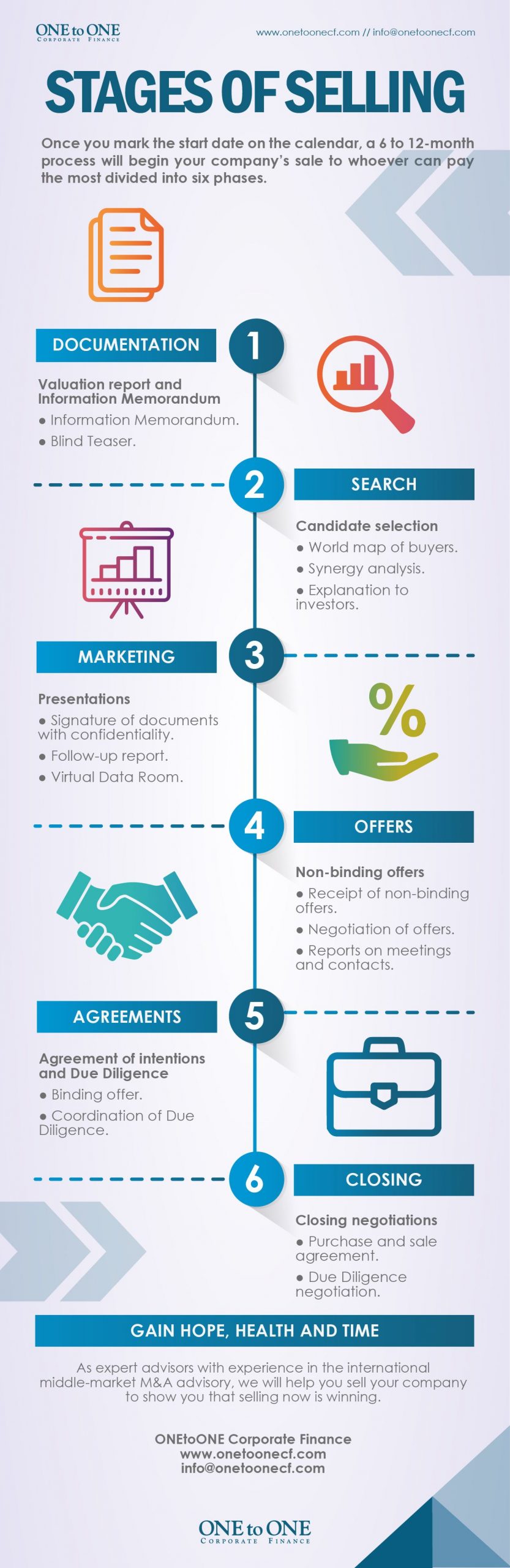
Stages of selling a company

As an owner, you may have considered selling your company, but you are unfamiliar with the procedure and are baffled by the technicalities involved. As specialists in the sale and purchase of companies, we help you understand the sale’s main stages.

The operation of buying and selling a company is a complex process that requires a team of advisors specialized in the company’s sector of activity. In general terms, the sale is structured in 6 stages: documentation, search, marketing, offers, agreements and closing. The following infographic will give you an idea of these six stages.

The transaction can take from 6 to 12 months. Its success depends mainly on selecting the best candidates, channelling the negotiations guaranteeing confidentiality and closing the most advantageous deal.

If you decide to count on ONEtoONE in this process, our advisors will work to obtain the highest profitability from the sale of your company and be by your side every step of the way.

About ONEtoONE

If you are looking to optimize the value of your investment within an operation, I encourage you to evaluate ONEtoONE Corporate Finance: a firm dedicated to provide the highest value services to their clients through transparency and professionalism.

At ONEtoONE we have a broad knowledge of the Mergers and Acquisitions sector, as we have participated in more than 1000 mandates. Our company is specialized in international middle-market M&A advisory. We are continuously focusing on improving the techniques to achieve the best possible price for our clients, and we also advise on acquisitions, strategic planning and valuation. We are pleased to give our opinion about company valuation or other aspects of a possible corporate operation. If you need an advisor while buying or selling a company,
contact us.

Economic reasons to sell a company

There are many different economic reasons for selling a company, and each owner has his or her senses. However, the reasons can group them into three main aspects: personal, family and financial. It is usually a combination of multiple reasons, both personal and financial. At ONEtoONE Corporate Finance, we want to help you with this challenging decision. Thus, we bring you the most common reasons for selling a company. In this article, we focus on the economic part; however, if you want to know more excuses, you can download our Ebook :

The company receives an offer:

On numerous occasions, a company directly receives an offer from the buyer. Most of the time, managers doubt if it is the best option. If this happens to you, you will need good analysts to advise you. 

Need for a new injection of resources:

On many occasions, companies need an increase in resources and goods. In the times we live in, everything changes very fast, and technology is increasingly advancing. For many businesses, this condition becomes unsustainable due to the need of constant investments. On these occasions, the business owners may conclude that it is better to sell the company than to continue investing in it and continue losing money.


Concentration in the sector:

When a sector tends to concentrate, it is an excellent opportunity to sell a company. In this circumstance, the business that is acquired is highly succulent for the buyer and, therefore, there is more negotiation margin and possibility of profit. We are currently experiencing a trend towards concentration in almost all sectors, especially those related to technology.

Decreasing profitability:

Sometimes a business can see its margins decrease over time. The company stagnates in a medium size in which it cannot benefit from the advantages of large companies, nor the flexibility of small ones. So, the owners may be interested in selling it to another one that can bring them more size, more profits and a reduction in costs that will increase the profitability.

Current crisis:

But if there is a situation that has put the world economy in check and has led to numerous sales, it is the current Coronavirus crisis. The pandemic has dramatically affected the business environment. That is why, as our president Enrique Quemada wrote, a large number of M&A operations are taking place daily worldwide. This situation leads to a high number of companies wanting to buy others, which means that is a great opportunity for you to sell.

Whatever your motive is, the sale of a company always ends in profit, in success.

Confidentiality and the Virtual Data Room

Confidentiality during an M&A process is vital for the success of an operation. One of the Corporate Finance Industry success metric is the levels of transparency between buyers and sellers, making confidentiality a crucial in any operation. A good M&A advisor also supports the transparency and confidentiality of the process.

Confidentiality and transparency have their protagonism during many phases of the process; in this article, we will refer specifically to the Virtual Data Room.

Managing confidentiality during an M&A Operation:

Managing confidentiality during this process is a crucial aspect within an operation. Usually the sellers seeks for higher levels of confidentiality but this metric may vary depending on many factors.

For example, if the seller wants a high level of confidentiality he must reduce the amount of potential buyers he reaches, but this will slow down the selling process. Vise versa, if the seller seeks faster results he must amplify his selection of possible buyers, making it more difficult to control the confidentiality factor. 

This may seem like a conflicting paradox for any seller because many business owners do not posses knowledge of the different techniques that can be applied to increase confidentiality during the M&A process.

What are some techniques we can refer to regarding confidentiality during an operation?

Creating a blind teaser: This document is designed to protect the identity of the company being sold when presented to potential investors. The teaser uncovers the situation of the company but not its name. If buyers show interest a confidentiality agreement is signed to protect such identity.

Signing an NDA: Confidentiality is crucial since day one. There will be a lot of agents involved in the process everyone that is exposed to this information must sign an NDA so the idea and intention is protected and safe.

Confidentiality Agreement: This document serves two purposes. The first one is to protect the selling company’s intentions regarding potential investors once they showed interest. The second one is that the signing of this document represent a clear intention of the buyer to proceed with a possible deal.

Data Room: If the deal has gone up to the point that there is the need to create a Data Room it means that we are near to the closing of an operation. In other words we are in a sensible point in which confidentiality is vital. That’s why Data Rooms are designed to protect information since they create a virtual space in which the seller will deliver all the documentation necessary to the potential buyer to proceed with the operation.

Defining the Virtual Data Room

A virtual data room (VDR) is a virtual space where the seller uploads all the necessary documentation of the company so the buyer can have access to it and advance in the process. This transaction of information is extremely delicate and must be made only when there is a trust-worthy and robust relationship between both parties, meaning that there is already the will to invest and close a deal.

The transaction of this information is made through unique online software design to prevent any disclosure of the documentation and keep-safe all the uploaded data. The software must be a high-quality product that provides confidence, security, and safety to both parties involved in the operation.

Imagine how hard it can be for a business owner to expose the essence of their company to someone. Leaving aside the emotional factors that make this operation hard, this part of the process must have all the requirements to ensure safety within the parties.

In every scenario, work-ethic and professionalism must be applied, but when referring to VDR’s we can assure that one of the best options in the market is EthosData. We invite you to take a look at their high-end Service that guarantees safety when taking care of your documentation.

In ONEtoONE we are characterized by the level of transparency, confidentiality, and professionalism with which we handle our clients’ operations. One of our best allies is the trust we generate through our work. Therefore, we encourage you to contact us if you are looking for advisory on buying or selling your company.

The best M&A advisor

Whether Buying or Selling a Company: Pick the Right Advisor

Written by Paul Hager, Partner of ONEtoONE Corporate Finance United States


Have you bought, or sold, a business lately? If you did, how do you know if you received optimal value on the deal? Did you ask an M&A advisor? It can take years before the value gained can be objectively measured, or even whether the result was a business success. Recent McKinsey and Harvard research shows that nearly 90% of all M&A deals fail to deliver the value expected, or achieve their M&A goals. How can this be?

Well-known, high-profile deals like Daimler-Benz-Chrysler; Time Warner-AOL; Quaker Oats-Snapple; Sears-Kmart; Google-Motorola; Sprint-Nextel, are extreme examples of deals not meeting expectations. A number of factors lead to poor M&A results. These include: simply paying too much; fundamental cultural mismatch; massive infrastructure incompatibilities; significant redundancies; or no product synergy whatsoever (i.e., the marriage simply wasn’t ever going to generate products customers would consider more valuable).

How to choose the best M&A advisor

As someone who has bought companies as a Fortune 500 investment committee member, and as a valuation and investment advisor for M&A clients, I’ve found the team you select to be your investment advisor plays a significant role in the amount of value created in the deal. I hope my thoughts might help you pick the right investment advisor, and significantly increase the likelihood of you achieving your M&A goals. Below, I’ve listed characteristics I think exist in all exceptional advisors.

1. Asks “Why?”

You’ve likely heard of Simon Sinek’s Golden Circle paradigm or Paul Ambruso’s use of the “5 Whys” to discern the root cause of success and failure. The “5 Why” approach was derived from Taiichi Ohno’s 1960s Toyota Production System methodology. Its purpose is to identify inefficiencies, waste and inconsistencies in manufacturing.

Most importantly, the technique can help people discover and objectively assess assumptions, biases, facts, priorities of any endeavor. Whether this be personal or professional. In our case, it applies to buying or selling a business. The “5 Why” method states that clear insight leads to the best decision. That insight is likely to come only after you’ve assessed answers to five iterations of “Why?”. For example, your investment advisor might ask:

  • “Why do you want to buy a business?
  • Why do you think buying another company will lead to greater innovation?
  • Why do you think this type of research capability will lead to needed innovation?

Asking “Why” throughout the M&A process leads to clearer understanding of why a certain type of company or investors would be the best match. Additionally, an exceptional advisor asks “Why” to constantly validate assumptions, eliminate wasted effort, explore new deal options, and sustain deal focus.

2. Understands your business

As an M&A advisor, there is no adequate substitute for deep understanding of a client’s operations and industry sector. Furthermore, having empirical insight into current and future industry trends, enabling technologies, and inter-dependent industries dramatically heightens the value ceiling. An exceptional investment advisor will use this insight, and that of her other industry experts, to further develop a set of optimal investment candidates for each client.

3. Spearfishes

Last year, a friend of mine told me of her exciting trip to Bora Bora (How nice is that?). She said the restaurant would take their dinner order the day before, so that snorkelers could search for the exact type and number of fish needed for their guests’ dinners. No waste in effort, time, or resources (fish not on the menu appreciated that). The diver knew the depth and location to find the type and size of desired fish.

An exceptional investment advisor will find those investors and companies that most value a specific client’s offering. By using the “5 Whys” and other analytic methods (e.g., Porter’s 5 Forces) to build a well-defined target profile, the advisor quickly identifies superior matches for each client.

4. Leverages global reach and local insight

It is sometimes more efficient and expeditious for advisors to contact corporate, institutional, and private investors with whom they regularly do business – “the usual suspects”. Due to established trust and understanding regarding these investors’ preferences and capabilities, advisors will work within their established networks. That’s understandable. But, the best strategic partner, the one that may most value the client’s offering is often not within any investor’s direct set of contacts.

The best advisor is one who will leverage an expansive global investor network that connects multiple industries. Investors who most value your offering may be in Singapore, Prague, Estonia, or Shanghai. They will also leverage access to trusted M&A colleagues with deep understanding of financial markets, industries, and companies in each region of the world. This allows them to open discussions with new investors and corporate networks that promise to hold greatest interest in the deal.

5. Takes business, personally

I surmise at least 60% of a company’s value is its people. Alternatively, if applying the Pareto Principal, 80% of a corporation’s value is its people. A good investment advisor is constantly mindful that M&A success depends on people to embrace and support implementation. As well as the fact that this is important both before and after the deal.

Having been an entrepreneur, and having also worked to grow small businesses for nearly twenty years, finding a successful M&A match helps to improve the lives of people in each company. Cultural rifts and redundancy layoffs can destroy the deal, its value, and peoples’ lives.

What are the benefits of following these steps?

Applying the previous four facets helps create and expand deal value. The best M&A advisor knows that business is personal. Furthermore, they know that the company’s greatest value asset must be supported, nurtured, and challenged. A successful M&A deal will do that. There are many exemplary investment banks and advisory groups around the world. Whether it be a top-tier large firm, or one with a boutique focus, these firms have phenomenal analytic research, and deal-making talent.

My only suggestion is that you chose an investment advisor who also possesses the five qualities mentioned above. In doing so, I am confident you’ll capture exceptional value in your deal.

If you are looking to optimize the value of your investment, I encourage you to evaluate ONEtoONE Corporate Finance. The firm is dedicated to providing the highest value services to their clients through transparency and professionalism. For more information click the button below.

About the author

Paul Hager

Paul Hager specializes in business innovation, growth strategies, and corporate finance., with over 30 years’ experience helping mid-market and Global 1000 companies grow corporate value through innovative business models, products, and operations. Paul has led and participated in corporate valuation; operational and organizational restructuring; Merger & Acquisition due diligence; value optimization; and closing M&A transactions. He joined ONEtoONE as a Partner in 2017, with principle focus on advanced digital and energy technologies.

About ONEtoONE

ONEtoONE is an international M&A firm with offices in 38 cities across the globe. Our goal is to optimize your work and increase the number and quality of your M&A transactions. We focus on working as a team to leverage each other’s strengths daily. We are experts in our field and can guarantee you a wide range of high-quality clients through our global network of boutiques.

Join us today to become a member of a global, dynamic team.

reasons to sell a business

Reasons to sell a business

The professional life of a business owner is made up of different stages that are constantly being overcome. The question is: which is the last stage that the business owner should reach? Usually, this happens when the following conditions come together:

  • Having reached professional and economic success.
  • Being relatively close to retirement.
  • Feeling dissatisfied and unhappy towards your business or work.

When these patterns come together, we are clearly in front of a situation that requires a change in the focus of life. This means that probably the original purpose from which the company was created has already being achieved, and hence its value has been lost. This is when the moment of considering a new life purpose, that goes in accordance with the current situation of the businessman, arrives. At this point, many reasons to sell a business may start to appear in the mind of a business owner.

selling process of a company

Two main reasons to sell a business

Working in our sector, we have witnessed wonderful stories of different business owners that have explained to us the main motives why they were selling their company. Usually, there are two types of reasons, economic and personal. Maybe you can relate to some of them. Let’s take a look:

Economic reasons:

  • A new competitor: We have seen many cases in which, within a sector, big corporations were acquired by strong venture capital institutions. This may be a scary trend for business owners that compete against such organizations, since they have less resources to stay in line. Therefore, this situation gives them a good reason to sell their business.
  • Decreasing profitability: This is always a strong sign for selling a business. In some cases, we have witnessed that the aggressive competition in the industry threatens companies that are not well structured internally. Therefore, they become less profitable with time. Don’t let his happen and read the signs, you might still be on time.
  • Need of capital injection: We live in extremely fast advancing times. For some businesses, it’s hard to adapt to the evolution of the industries, since this requires a huge investment. Competition may evolve faster and put your business in danger. The need of capital is a good reason to consider selling your business.

Personal reasons:

  • Retirement: This is one of the most common reasons for a business owner to sell their company. Many owners have gone through a long path to build their company from scratch. It is hence normal for a business owner that has reached professional maturity, to feel tired and in desire of some peace and quiet at last.
  • Change of lifestyle: This motive goes in hand with retirement. Business owners usually seek fulfillment in other aspects of life once they reach professional maturity. Some want to dedicate themselves to giving back to society, others want to spend time with their family, and others simply want to enjoy the perks of a good life.
  • Health Conditions: Owning a business is extremely stressful and requires the person to be in an optimal state of health. Sometimes, nature denies this privilege and selling the business may be the best option to avoid losing all the effort and investment of a lifetime.

These are some of the main reasons to sell a business, but the important question is: how would the business owner feel after the sale?


The after-taste

After selling the business, many business owners stop experiencing the sensation of dissatisfaction and unhappiness. They are able to make a decision that allows them to confront a new professional challenge. Moreover, they can choose to do something that contributes to society and their loved ones.

Despite this, many business owners fear to finish their professional stage. It is common that they have uncertainty about what might happen after the sale. However, once the company has been sold, the businessman enters a new phase in his life full of freedom. Now that they have complete control of their time and resources, they can focus on their life, new objectives, and even dreams.

Moreover, the predominant sensation is of pride and satisfaction thanks to a good company valuation and a successful sale. The business owner sees how the efforts and hard work are recognized and will continue to deliver results for many years to come.

Having said that, if you need further information about the selling process of a company, we put at your disposal our team of highly qualified advisors. When there are more than a few reasons to sell a business it’s time to ask yourself “the” question.

m&a advisors